
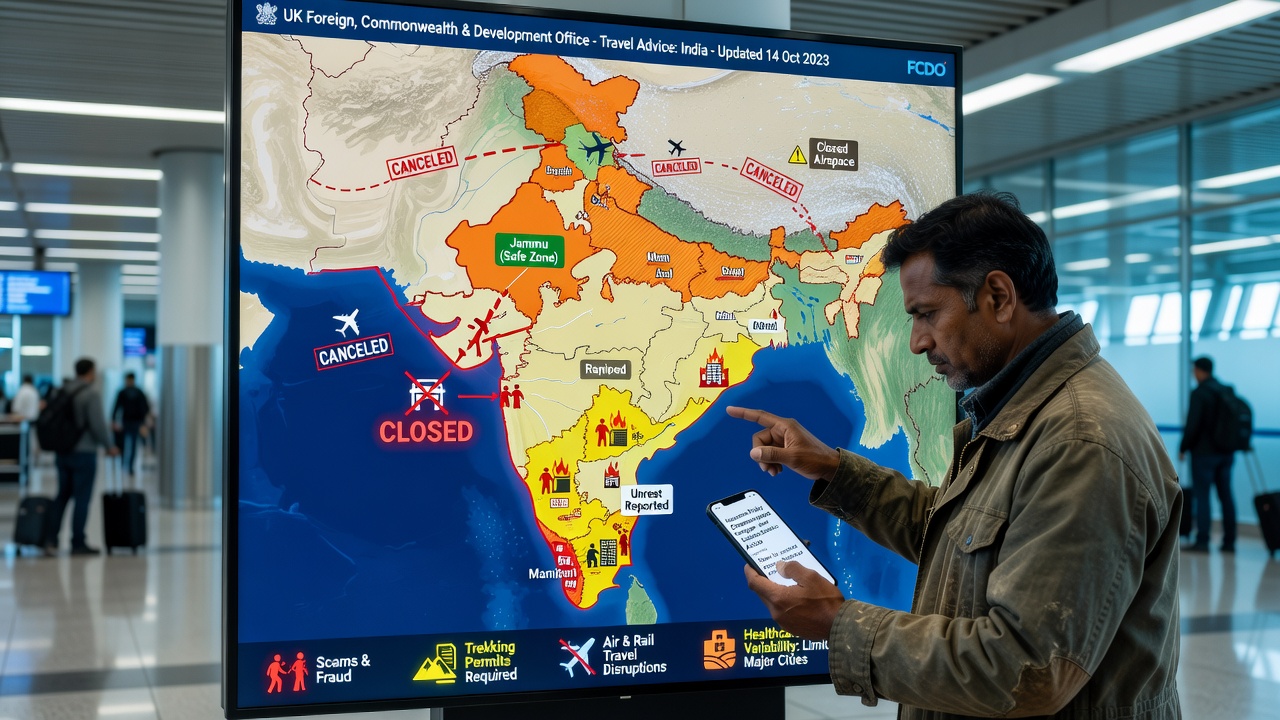
The UK Foreign, Commonwealth & Development Office (FCDO) has revised its travel guidance for India, refreshing sections on entry requirements, safety and security, and health. The changes follow a routine accuracy review rather than a single triggering incident, but they carry practical consequences for anyone planning travel to India, including implications for travel insurance validity.
Why Border and Conflict Zones Still Matter
The FCDO continues to advise against all travel within 10km of the India-Pakistan border, with the Wagah-Attari crossing closed to general travellers aside from the daily retreat ceremony. Guidance also maintains that travel to Jammu and Kashmir should be avoided, with narrow exceptions for air travel to Jammu city and movement within it. Manipur remains subject to an "essential travel only" advisory, reflecting continued curfews and unrest linked to ethnic violence that began in 2023. These are not cosmetic distinctions. Insurance providers typically tie coverage directly to government travel advice, so entering an advised-against area can void a policy entirely, leaving travellers personally liable for medical evacuation, hospital costs, or legal assistance.
Regional Instability Beyond India's Borders
Escalation in the Middle East has produced knock-on effects far from the immediate conflict zones, including airspace closures and widespread flight delays and cancellations. Travellers transiting through affected airspace, even en route to or from India, face a genuine risk of disruption. The FCDO's advice here is practical rather than alarmist: check advice for every country on an itinerary, not just the final destination, confirm the latest position with airlines or tour operators, and verify that travel insurance explicitly addresses disruption-related costs such as rebooking or extended stays. Travellers whose visas are affected by delays are directed to the nearest Foreigners Regional Registration Office, a detail that matters for anyone whose visa validity window is tight.
What the Health and Safety Updates Reflect
The revisions to scams, trekking safety, and air and rail travel guidance point to an ongoing effort to keep advice aligned with how people actually travel in India today, rather than static boilerplate. Trekking routes carry specific risks around permits and remote-area rescue capacity, which is why access permit information has been refreshed. Updated healthcare guidance also signals attention to the variability of medical facilities across India, particularly outside major cities, reinforcing why comprehensive travel insurance with medical evacuation cover is not optional for independent or adventure travel.
Practical Implications for Travellers
None of this advice guarantees safety, and the FCDO is explicit that no travel can be guaranteed risk-free. What the guidance offers is a framework for informed decision-making rather than a prohibition. For travellers weighing a trip to India, the sensible approach involves treating the advice as a baseline, not a formality to skim past before booking.
- Confirm insurance coverage explicitly excludes or includes advised-against zones
- Check transit country advice, not just the final destination
- Reassess health cover for remote trekking or rural travel
- Monitor advice updates by signing up for alerts before departure