
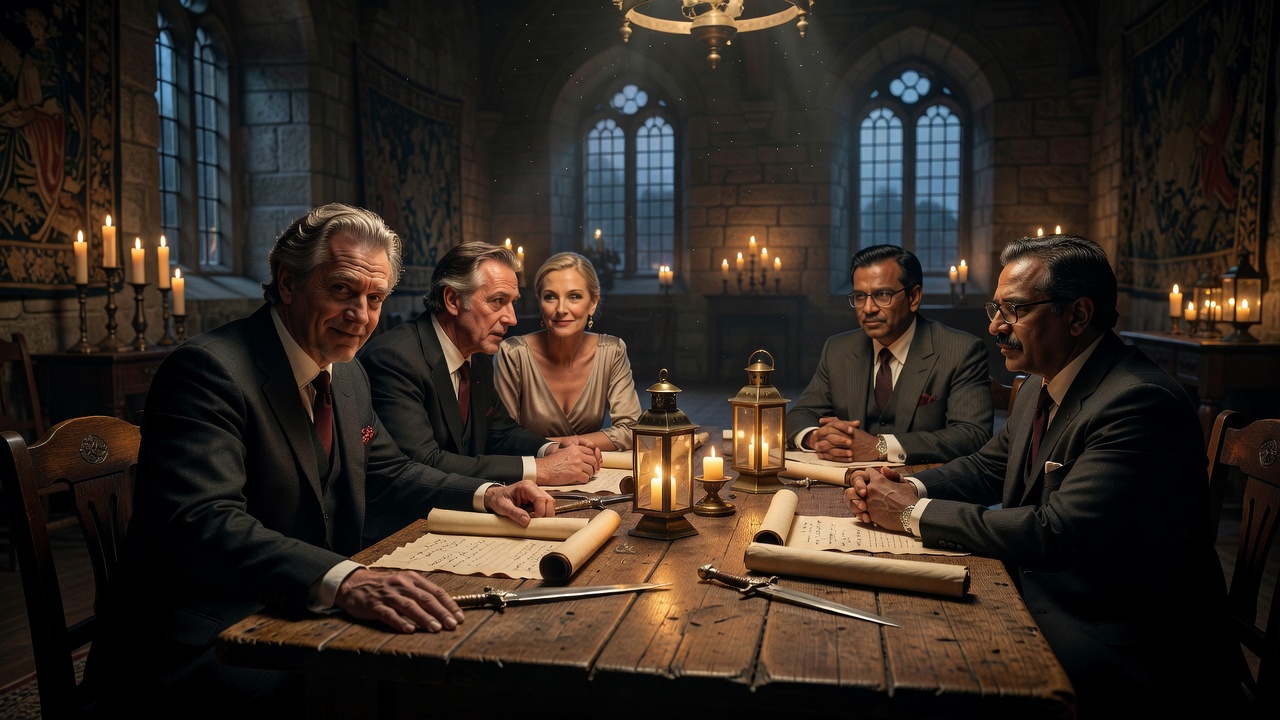
Almost nine million people tuned in to watch the opening episode of the second series of Celebrity Traitors, a jump of roughly three million on the launch of the previous run. The BBC format, which pits a star-studded cast including Richard E Grant, Michael Sheen, Jerry Hall and Romesh Ranganathan against each other in a game of deception and deduction, has become one of the rare pieces of television capable of pulling a fragmented audience back to appointment viewing. Speaking to Today in Focus, TV critic and broadcaster Scott Bryan explored why the show has managed this feat at a moment when most broadcasters are losing the battle for attention.
Why a parlour game beats the algorithm
Traitors works because it strips entertainment back to something almost pre-digital: a group of people in a room, lying to each other, while the audience is let in on the secret. There are no betting markets, no streaming rights war, no second-screen app required to follow along. That simplicity is precisely what cuts through in a media environment saturated with on-demand content competing for the same eyeballs. Celebrity casting adds a further layer, inviting viewers to project existing impressions of well-known figures onto a format built on misdirection.
Live television's shrinking but stubborn appeal
Linear broadcasters have spent years losing ground to streaming platforms, yet formats built around unpredictability and shared social conversation continue to resist that decline. Traitors belongs to a small category of programmes, alongside major sporting fixtures and televised talent contests, where watching live and discussing the twists in real time is part of the value. That dynamic matters commercially: audiences watching together, at the same hour, are far more valuable to a broadcaster's schedule and advertising proposition than the same numbers spread thinly across a week of catch-up viewing.
The wider pull of chance-based entertainment formats
The show's mechanics, in which contestants are secretly assigned roles and must bluff their way through group decisions, tap into something familiar from games of chance and hidden information more broadly. Audiences enjoy the tension of not knowing an outcome and watching others try to read probability and behaviour under pressure. That psychological appeal is not unique to television; it underpins much of the broader entertainment and gaming industry, where uncertainty is the product. The distinction worth holding onto is that Traitors carries no financial stake for the viewer. There is no wager attached to guessing who the traitors are, which is part of why it functions as shared, low-risk entertainment rather than anything resembling a betting product. Any genuine wagering market built around a television format would need to be clearly licensed, transparent about odds, and separated from the emotional pull of the show itself.
What the ratings signal for broadcasters
For the BBC, the scale of the audience is a reminder that format innovation, rather than star power alone, still drives appointment viewing. For rival broadcasters and streamers, it is a prompt to reconsider how much value lies in communal, unpredictable formats at a time when personalised recommendation algorithms dominate most viewing choices. The success of Celebrity Traitors suggests that audiences have not lost their appetite for shared uncertainty; they have simply been offered fewer chances to experience it collectively.