
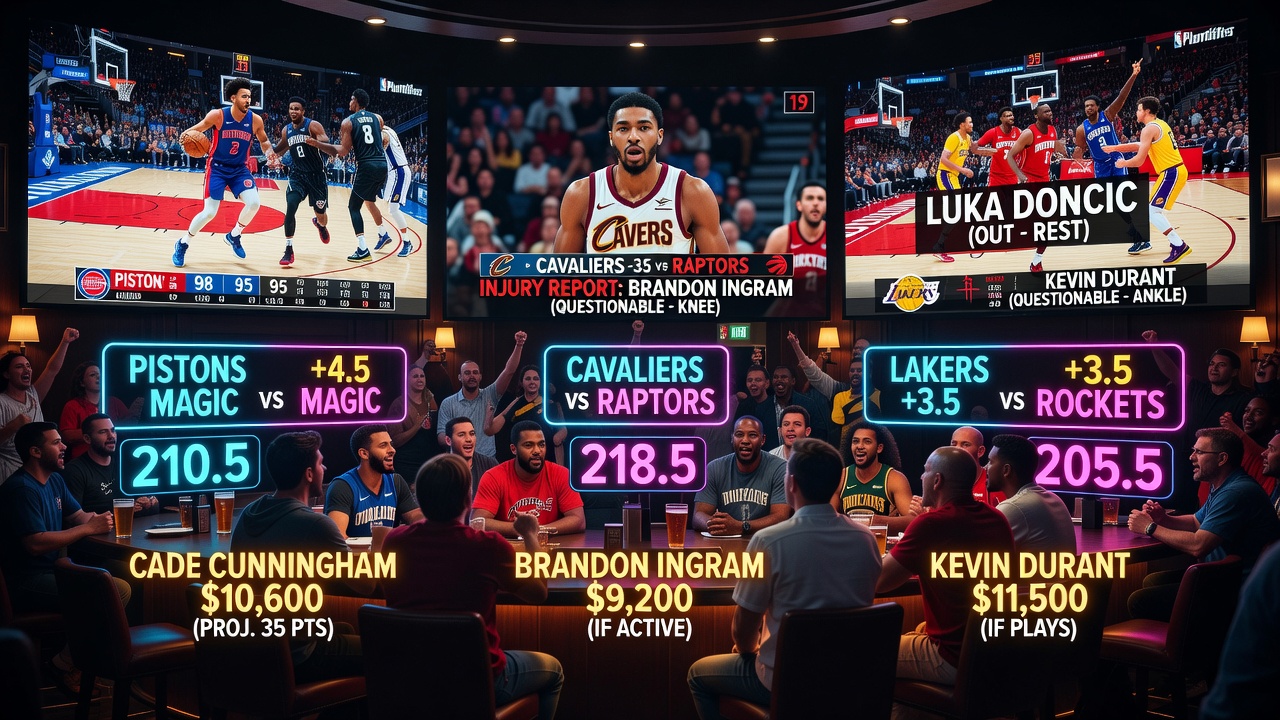
Three closeout opportunities headline Friday's NBA playoff slate, and the betting lines reflect genuine uncertainty rather than foregone conclusions. Detroit, Cleveland and the Lakers all face different versions of win-or-adjust pressure, and sportsbooks have priced each matchup accordingly, with point spreads ranging from a tight 3.5 points to a slightly wider 4.5. For bettors and daily fantasy players alike, injury news is doing as much work as raw talent in shaping these markets.
Why Injury Reports Move Lines More Than Box Scores
The Pistons-Magic line opened with Detroit favored by 3.5 despite Orlando missing Franz Wagner entirely, a sign oddsmakers still trust Cade Cunningham's recent 45-point outburst to translate into sustained value. Tobias Harris carries a questionable tag with an ankle issue, which matters not just for Detroit's rotation but for any prop market tied to his minutes. Meanwhile, Cleveland enters as a clear favorite against Toronto despite a clean injury report, while the Raptors' hopes hinge partly on clarity around Brandon Ingram. In the Lakers-Rockets game, Luka Doncic's continued absence has been priced into Houston's favorite status, even as Kevin Durant remains questionable with an ankle concern. This is standard practice in sports betting: markets react less to season-long averages and more to who is actually available on a given night.
What the Totals Reveal About Market Expectations
Each game's total - 210.5 for Pistons-Magic, 218.5 for Cavaliers-Raptors, and 205.5 for Lakers-Rockets - reflects oddsmakers' read on pace and defensive intensity typical of elimination basketball. Historically, win-or-go-home games tend to see tighter defensive execution, which is why none of these totals sit particularly high despite star power on both sides. BPI projections from ESPN Analytics diverge from the betting lines in at least one case: Toronto is projected to win outright despite being a 4.5-point underdog, illustrating how statistical models and market pricing don't always align. That gap is worth watching, not as a guaranteed edge, but as a reminder that point spreads incorporate public perception and betting volume alongside pure performance data.
Daily Fantasy Pricing and the Role of Usage Rate
In daily fantasy formats, salary tiers are built around recent usage and minutes, not just name recognition. Cunningham's $10,600 price tag corresponds to a 35.5% usage rate and over 40 minutes per game in this series, making him the clear focal point in any Pistons-based lineup. Lower-tier options like Anthony Black ($4,700) and Rui Hachimura ($4,900) illustrate how opportunity - in Black's case, created directly by an injury to Wagner - can outweigh raw talent rankings when building a roster on a budget. Jabari Smith Jr.'s consistency at $6,700 is a reminder that DFS value often comes from predictability of role rather than ceiling.
Reading Props and Spreads With Appropriate Caution
Player props such as Tobias Harris reaching 24-plus combined points and rebounds, or Austin Reaves scoring 25-plus points, are built from sample sizes as small as four or five recent games. That is useful context, but it is not a forecast. Injury status, matchup adjustments, and in-game foul trouble can all shift outcomes regardless of recent form. None of the figures here - fantasy point averages, usage rates, or odds - guarantee results, and bettors should treat all pricing, from spreads to DFS salaries, as a reflection of probability rather than certainty. Responsible engagement with these markets means treating injury reports and advanced stats as decision-support tools, not predictive locks.