
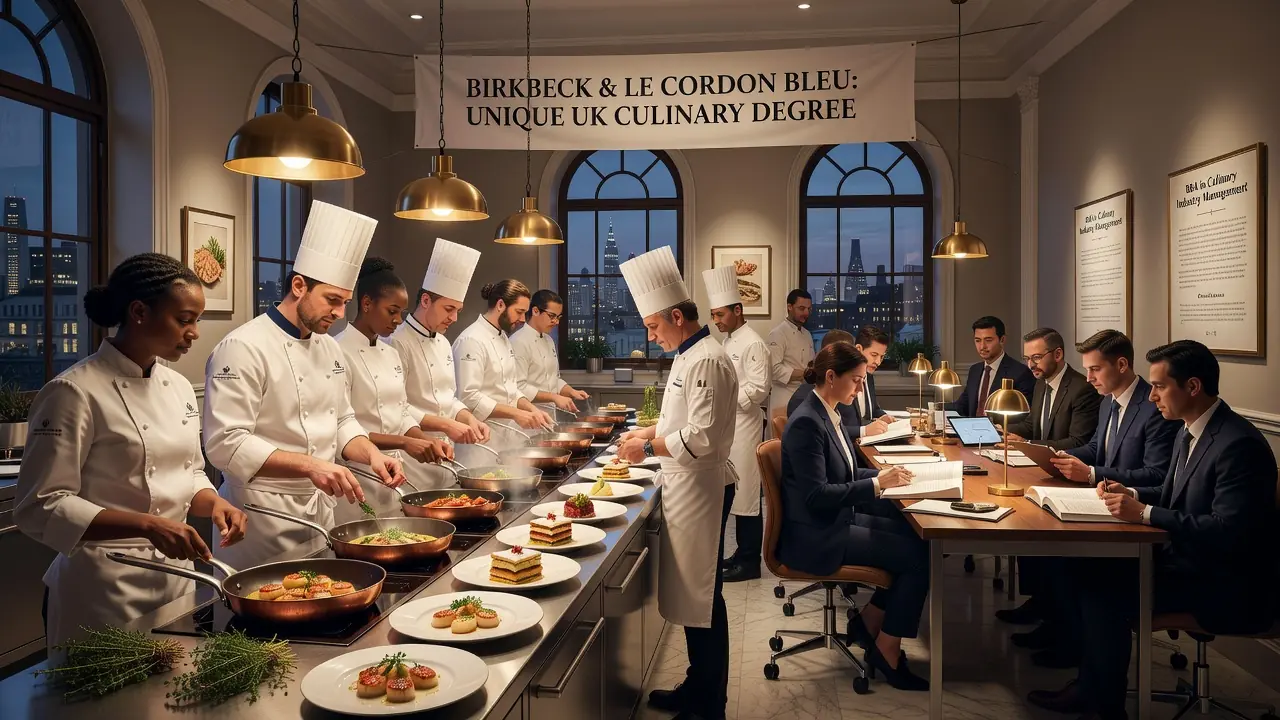
A new business degree aimed at Britain's kitchens and hospitality boardrooms is taking shape through an unusual academic partnership. Birkbeck, University of London, has joined forces with Le Cordon Bleu Culinary Arts Institute to deliver a BBA in Culinary Industry Management, described as the only programme of its kind in the UK. The course sits at the intersection of professional cookery training and formal business education, a combination rarely offered through a single degree pathway.
Two institutions, one qualification
The structure reflects the dual identity of the hospitality sector itself, where technical skill and commercial literacy are both essential. Business and management modules are delivered by Birkbeck, drawing on its standing in management research, while professional culinary modules are taught at Le Cordon Bleu's London centre by its team of classically trained chefs. Students typically attend two classes at each institution weekly, with Le Cordon Bleu's evening sessions running from 6.30pm to 9.30pm, and first-year culinary classes extending from 3.00pm to 9.30pm. Birkbeck occasionally offers afternoon sessions for select modules, giving the timetable some flexibility for those balancing study with other commitments.
Industry links and the internship model
What distinguishes the course from a conventional culinary qualification is its embedded industry pipeline. Students complete an internship between their first and second years with employers that include the Savoy, Maybourne Hotel Group, Hyatt Hotels, Corinthia London and the Wolseley Hospitality Group, among others. This mirrors a broader shift in vocational higher education, where degree value is increasingly judged on direct employer engagement rather than classroom theory alone. Assessment methods reflect the hybrid nature of the course too, combining practical culinary examinations with essays, case studies, group projects and a final research piece, so graduates leave with evidence of both technical competence and analytical capability.
Access routes and entry considerations
Entry requirements are set at 96-112 UCAS tariff points for the standard three-year route, equivalent to grades CCC-BBC at A-level, while a four-year route including a Foundation Year requires 64 points. The Foundation Year option is designed for applicants returning to education after a break, those without the required subject background, or those who narrowly missed standard entry grades, with automatic progression onto the main degree upon completion. Birkbeck states it also considers applicants without traditional qualifications, assessing prior work experience and knowledge on a case-by-case basis, which widens access for career-changers already working in food service.
- GCSE grade C/4 (or equivalent) typically required in English and mathematics
- International applicants generally need IELTS 6.5 overall, minimum 6.0 per component
- Full-time study is required for Student visa sponsorship; part-time options are not visa-compliant
- Free Institute of Hospitality membership is available to enrolled students
For international students, the visa implications are significant: only full-time, on-campus study qualifies for sponsorship, and those on a Student visa cannot switch to part-time modes. This is a practical compliance point rather than an academic one, but it shapes who can realistically access the course and how. As hospitality employers continue to seek staff who understand both the stove and the spreadsheet, programmes structured this way point to where vocational higher education may be heading more broadly.