
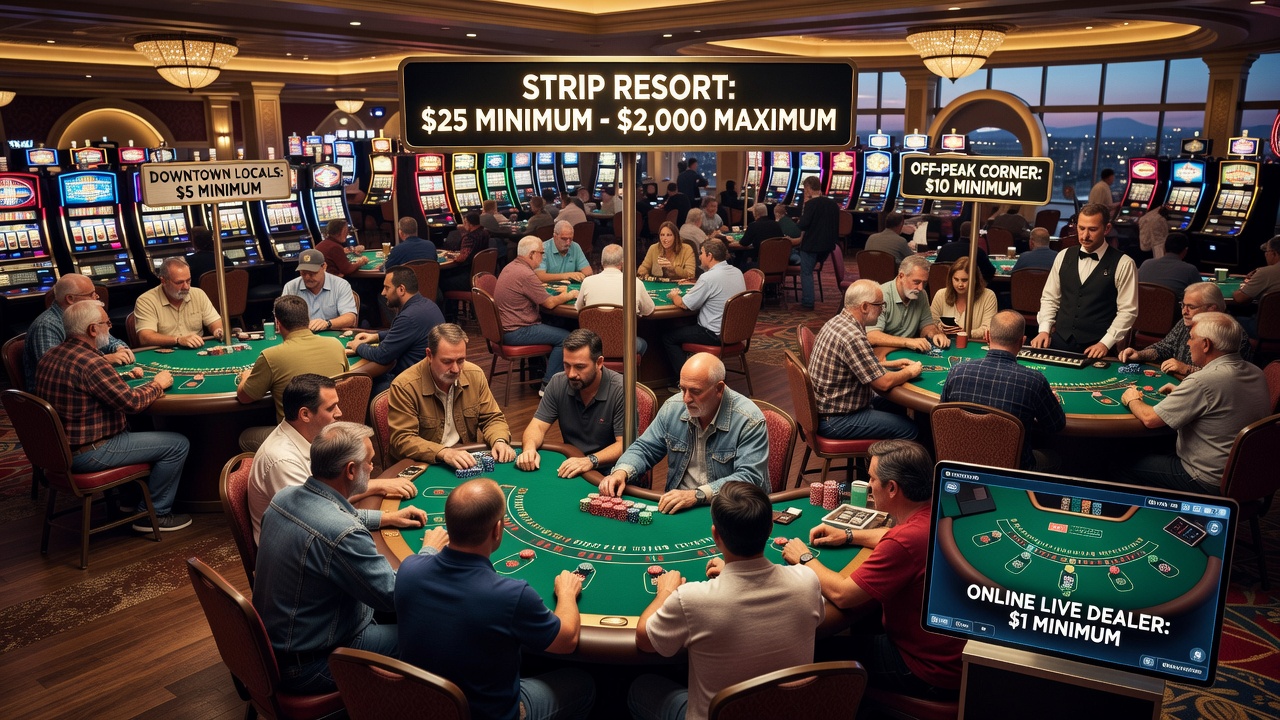
A $5 blackjack table barely exists anymore on the Las Vegas Strip. Walk into most casinos on a Friday night and the entry point has quietly climbed to $15, $25, or even $50 per hand, while the same game sits at $10 in a quieter downtown room or a regional casino two hours away. The gap between these numbers isn't random pricing - it reflects a calculated business decision that shapes who sits at the table and how much the house expects to earn per square foot of floor space.
Understanding why these thresholds exist, and how they shift depending on time, location, and even the specific dealer's shift, gives players a real edge in planning a session. Casinos post their limits on a small sign at each table, but the logic behind that number is rarely explained anywhere near it. Knowing exactly what is the minimum bet in blackjack at a given table can mean the difference between a relaxed two-hour session and burning through a bankroll in twenty minutes. The rules governing these limits aren't arbitrary - they follow predictable patterns tied to casino economics, staffing, and even the layout of the gaming floor.
This piece breaks down how minimum wagers are set, why they vary so widely, and what practical steps a player can take to find a table that fits their budget without sacrificing a good playing experience.
What "Minimum Blackjack Bet" Actually Means
The minimum blackjack bet is the smallest amount a player must place on the betting circle to receive a hand at a given table. It is not a suggestion - it is a hard rule enforced by the dealer and pit staff. Attempt to bet below the posted figure and the dealer will decline to deal you in, regardless of how quiet the table is.
The Table Sign and What It Tells You
Every legal blackjack table displays a small placard, usually near the dealer's chip tray, listing the minimum and maximum wager accepted. This sign is a binding contract between the casino and the player for that specific table at that specific time. Casinos frequently update these placards throughout the day - a table showing a $10 minimum at noon might display $25 by 8 p.m.
Minimum vs. Maximum: Two Sides of the Same Rule
Blackjack betting limits always come in pairs. The lower figure protects the casino's expected revenue per hand; the upper figure caps the casino's risk exposure to a single player on a hot streak. A table with a $15 minimum and $2,000 maximum, for instance, is designed for casual players who might occasionally press a bet upward, not high rollers.
Why the Amount Isn't Universal
There is no single number that applies across an entire casino, let alone across the industry. The lowest bet in blackjack at one pit can be triple the amount at another pit twenty feet away, simply because one section is designated for higher-volume, higher-stakes play.
How Casinos Set Blackjack Table Minimums
Casino floor managers set minimums using a formula that balances expected hourly revenue against table occupancy. A table that sits empty because the minimum is too high generates zero income; a table that fills up quickly with $5 bettors generates steady but modest income. The goal is always to find the threshold that maximizes revenue per square foot without driving players away.
Location Within the Casino
Tables near the entrance or in high-traffic pits typically carry higher minimums because foot traffic alone guarantees players will sit down regardless of price. Tables tucked into corners or upper floors often carry lower minimums to compensate for lower visibility.
Time of Day and Day of the Week
Casinos adjust the minimum wager required in blackjack tables based on demand cycles. Weekday afternoons often see lower thresholds to keep tables staffed and active; weekend evenings, when demand for seats outpaces supply, see minimums rise sharply.
Staffing and Dealer Costs
Every open table requires a dealer, and dealers cost money regardless of how much action the table generates. A casino will raise the blackjack table minimum on a slow table rather than close it, since even modest action from higher bets offsets the dealer's wage more efficiently than a full table of small bettors.
Lowest Bet in Blackjack: Where to Find It
Players hunting for the lowest bet in blackjack should think beyond the Las Vegas Strip. Downtown casinos, regional properties, and riverboat casinos in smaller markets consistently offer lower entry points than resort-style properties competing for high-spending tourists.
Downtown and Regional Casinos
Smaller markets rely on repeat local business rather than one-time tourist spending, so they tend to keep minimums low to encourage frequent visits. A $5 or $10 table is still findable in these environments, particularly on weekday mornings.
Off-Peak Hours on the Strip
Even premium properties drop their minimums during slow hours - typically early morning or midweek afternoons. A table that requires $25 per hand at 9 p.m. might drop to $10 at 10 a.m. the next day.
Online Casinos and Live Dealer Tables
Digital platforms have reshaped the lower end of the market entirely. Many online live dealer blackjack tables accept wagers as small as $1, a figure no physical casino floor could sustain given staffing costs. This makes online play the most reliable option for anyone specifically seeking the smallest possible entry point.
- Downtown casinos: often $5-$15 minimums
- Strip resorts, peak hours: $25-$100 minimums
- Strip resorts, off-peak hours: $10-$25 minimums
- Online live dealer tables: as low as $1-$5
Blackjack Betting Limits and What They Mean for Your Bankroll
Choosing a table isn't just about finding the cheapest seat. Betting limits directly influence how long a bankroll lasts and how much variance a player will experience during a session.
Bankroll-to-Minimum Ratio
A common guideline among experienced players is to have at least 20 to 40 times the table minimum available before sitting down. A $500 bankroll comfortably supports a $15-$25 table, but stretches thin at a $50 minimum table, where a short losing streak can end the session quickly.
Spread Betting Within Limits
Some players use the gap between the minimum and maximum to adjust their wager based on the count or the flow of the shoe. This strategy only works at tables with a wide spread - a table with a $25 minimum and $500 maximum offers far more flexibility than one capped at $100.
Session Length vs. Bet Size
Lower minimums generally mean longer sessions for the same bankroll, which suits players who value time at the table over the size of individual wins. Higher minimums compress session length but increase the potential payout per hand.
Minimum Wager Required in Blackjack: Rules and Exceptions
The minimum wager required in blackjack isn't always a single flat figure. Certain rules and side conditions can change what a player actually needs to place on the felt.
Side Bets and Their Separate Minimums
Side bets like Perfect Pairs or 21+3 often carry their own minimum, independent of the main wager. A table might require a $15 main bet but only $1 for the side bet, giving players a low-cost way to add variance without increasing their core exposure.
Table Changes Mid-Session
Casinos can raise a table's minimum while a player is seated, though most properties honor the original limit for players already in a hand. It's common courtesy, not always a legal requirement, so confirming with the dealer before continuing is worthwhile.
Comped Play and Minimum Requirements
Players using casino loyalty programs sometimes must meet a specific average bet size, tied closely to the table minimum, to qualify for comps like free rooms or meals. Sitting at the lowest-limit table available may reduce comp eligibility even if it fits the bankroll better.
Practical Tips for Choosing the Right Table
Selecting a blackjack table intelligently comes down to matching personal bankroll, risk tolerance, and time availability with the right minimum and maximum combination.
Scout Before You Sit
Walk the pit before committing to a seat. Minimums can vary significantly between tables just a few feet apart, and a short walk can save considerable money over a multi-hour session.
Ask the Pit Boss for Off-Peak Recommendations
Pit staff know which tables tend to drop their minimums during slower periods. A direct question often yields useful, specific answers that aren't posted anywhere visible.
Match the Table to the Trip's Purpose
A casual weekend visit calls for a different strategy than a dedicated bankroll-building session. Lower minimums suit longer, lower-stress play; higher minimums suit shorter sessions aimed at bigger swings.
Frequently Asked Questions
Can a casino change the table minimum while I'm still playing?
Yes, technically a casino can adjust the posted minimum at any time, but most properties allow players already seated to continue at the original rate until they leave the table. Always confirm with the dealer if you notice the sign change mid-session.
Is the lowest bet in blackjack always $5 in physical casinos?
No, $5 tables have become rare in major markets. Many properties now start at $10, $15, or $25, though smaller regional and downtown casinos still occasionally offer $5 minimums, especially during off-peak hours.
Do online blackjack tables have lower minimums than physical casinos?
Generally yes. Online and live dealer platforms can offer minimums as low as $1 because they don't carry the same staffing and floor-space costs as a physical casino, making them the best option for players with a small bankroll.
Why do minimums increase in the evening?
Evening hours bring higher demand for available seats, and casinos raise minimums to manage that demand while maximizing revenue per table. Fewer tables are needed to serve the same number of players when minimums rise.
Does a higher table minimum mean better odds for the player?
Not necessarily. The house edge is determined by the specific rule set at the table - number of decks, dealer standing rules, doubling restrictions - not by the size of the minimum bet. A $10 table can offer better odds than a $100 table if its rules are more favorable.
How much bankroll do I need for a $25 minimum table?
A common guideline suggests carrying at least 20 to 40 times the minimum bet, so a $25 table calls for roughly $500 to $1,000 to sustain a reasonable session length and absorb normal losing streaks without running out of funds.