
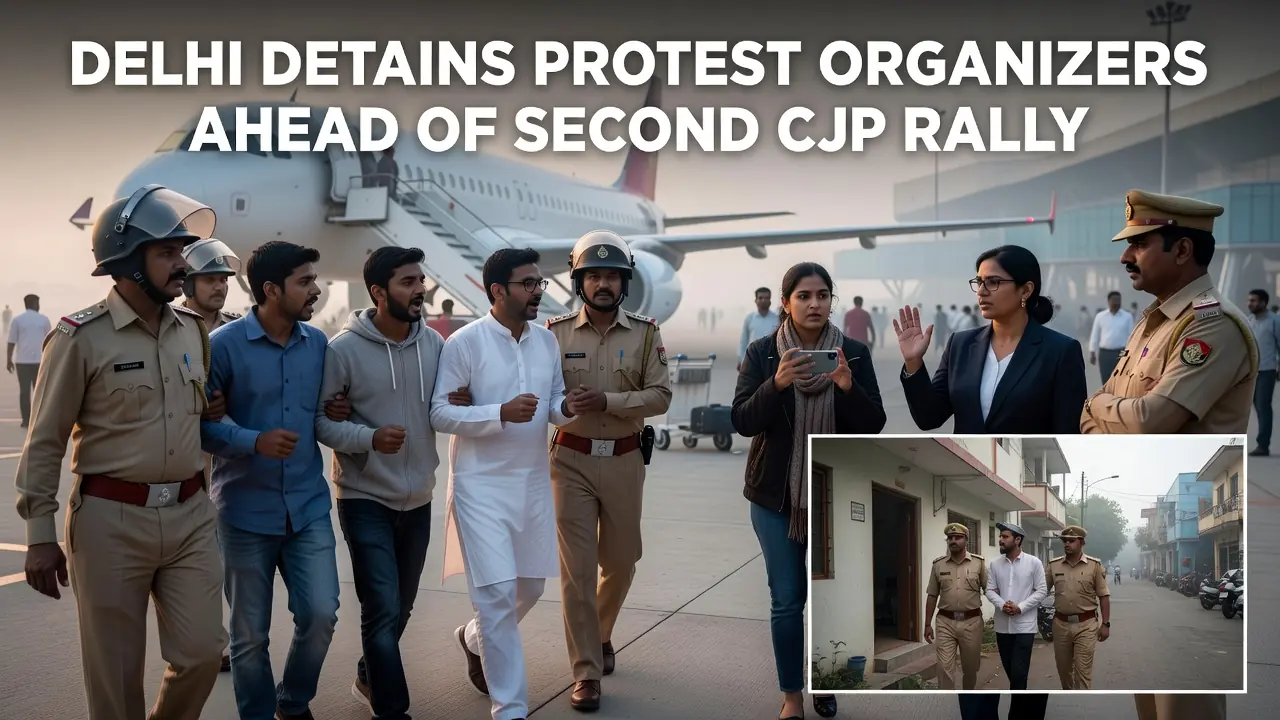
Delhi Police moved before dawn, detaining activists, a prominent YouTuber and legal advisers tied to the Citizens for Justice Platform (CJP) within hours of their arrival in the capital. Among those picked up were Abhijeet Dipke, Saurav Das and Ashutosh Ranka, reportedly taken off their flight shortly after landing, along with content creator Kavya Karnatac and CJP legal head Ratna Singh. Police say roughly 600 people have been detained in total, a figure that includes around 50 individuals described as having prior criminal records, as authorities lock down parts of the city ahead of a planned demonstration calling for the resignation of Chief Election Commissioner Gyanesh Kumar.
What triggered the pre-emptive detentions
The detentions came just before a second scheduled protest against the CEC, following an earlier demonstration that drew national attention. Dipke, before departing for Delhi, publicly invoked Article 19 of the Constitution - which guarantees freedom of speech and the right to peaceful assembly - and challenged authorities to arrest him if they intended to stop the protest. That challenge appears to have been met almost immediately, with CJP releasing video of the detentions soon after landing. YouTuber Dhruv Rathee, who commands a following in the millions, was also detained, this time from his residence in Gurugram rather than at the protest site itself.
Detention before dissent: the legal tension
Indian law permits police to detain individuals preventively if there is a reasonable apprehension of a breach of public order, but the threshold for such action is supposed to be specific and evidence-based, not a blanket sweep ahead of an anticipated gathering. Critics argue that detaining organizers before they even reach a protest site - rather than responding to any actual disturbance - effectively nullifies the right to assembly guaranteed under Article 19(1)(b). Supporters of the police action frame it as a standard law-and-order measure in a capital that has seen large, sometimes volatile demonstrations. The claim that 50 of the 600 detained have "criminal backgrounds" is being used by authorities to justify the scale of the operation, though no further detail on what that designation means, or how it was verified, has been made public.
Why this moment matters beyond Delhi
The protest itself is aimed at Chief Election Commissioner Gyanesh Kumar, placing the Election Commission - the body meant to referee India's democratic contests - at the center of a dispute about its own neutrality. When demonstrators organizing around electoral integrity are detained before they can speak publicly, the optics work against the government regardless of the legal justification offered. Detaining a high-profile independent commentator like Rathee from his home, rather than at any protest, adds another layer: it signals that proximity to a cause, not participation in unrest, can be enough to trigger police action. For a democracy that prides itself on peaceful transfers of power and open contestation of its election machinery, the question raised by this episode is less about the legality of any single detention and more about what message a pattern of pre-emptive action sends to ordinary citizens weighing whether to show up at all.