
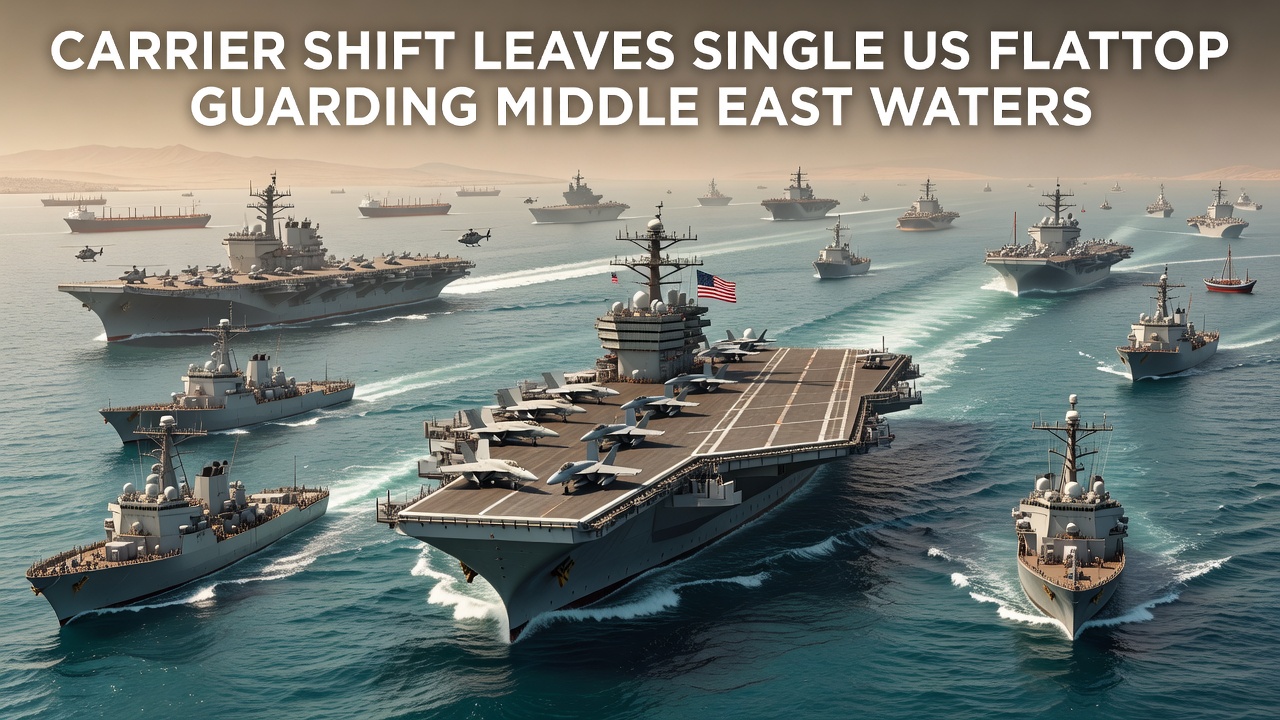
The US Navy's presence in the Middle East has thinned to a single aircraft carrier, after the USS George H.W. Bush and its escort destroyer, the USS Delbert D. Black, pulled out of the Arabian Sea and sailed toward Southeast Asia. The Bush docked in Phuket, Thailand, on October 4 for a scheduled port visit, closing out months of operations in a region that has remained a persistent flashpoint for American naval planning.
With the Bush gone, the USS George Washington is now the only US carrier stationed in the Middle East, a gap the Pentagon appears to be managing with the Theodore Roosevelt and the amphibious assault ship Makin Island both reportedly moving toward the theater.
Why Carrier Rotations Matter
Aircraft carriers are the most visible instrument of American military reach, and their movements are read closely by allies and adversaries alike. A single carrier holding the Middle East, even temporarily, signals either confidence that the immediate threat picture has eased or a calculated bet that reinforcements will arrive before any gap becomes exploitable. Port visits like the one in Phuket serve a dual purpose: they give crews rest after extended deployments and they reinforce diplomatic and military ties with regional partners such as Thailand, a longstanding US treaty ally in the Indo-Pacific.
Carrier strike groups do not operate in isolation. Each deployment involves escort destroyers, cruisers, support vessels, and extensive logistics chains spanning fuel, munitions, and personnel rotation. Pulling a carrier like the Bush out of one theater and routing it toward another is rarely a snap decision; it reflects months of scheduling built around maintenance cycles, crew readiness, and shifting strategic priorities.
A Region That Rarely Stays Quiet
The Middle East has been a near-constant draw on US naval resources for decades, with tensions involving Iran, shipping security in the Arabian Sea and Gulf, and the broader stability of energy trade routes all factoring into deployment decisions. The temporary thinning of carrier presence does not necessarily indicate reduced concern about the region. Naval planners routinely balance competing demands across the Indo-Pacific, Europe, and the Middle East, and a single flattop holding position while others transit toward the theater is a familiar pattern rather than an anomaly.
The incoming Theodore Roosevelt and Makin Island suggest the Navy intends to maintain, or even expand, its footprint once they arrive. Amphibious assault ships like the Makin Island bring a different capability set than a traditional carrier, often supporting Marine Corps operations, humanitarian missions, or rapid-response scenarios, which adds flexibility to whatever posture the US settles into once the reshuffle is complete.
What the Movement Signals Beyond the Headlines
These rotations are logistical realities as much as strategic statements. Carriers need maintenance, crews need rest, and alliances need tending through visits like the one in Phuket. Readers tracking these deployments should be cautious about overreading a single moment in a rotation schedule as evidence of a dramatic policy shift. The more telling signal will come from how long the Washington operates alone, and how quickly the Roosevelt and Makin Island settle into the region once they arrive.