
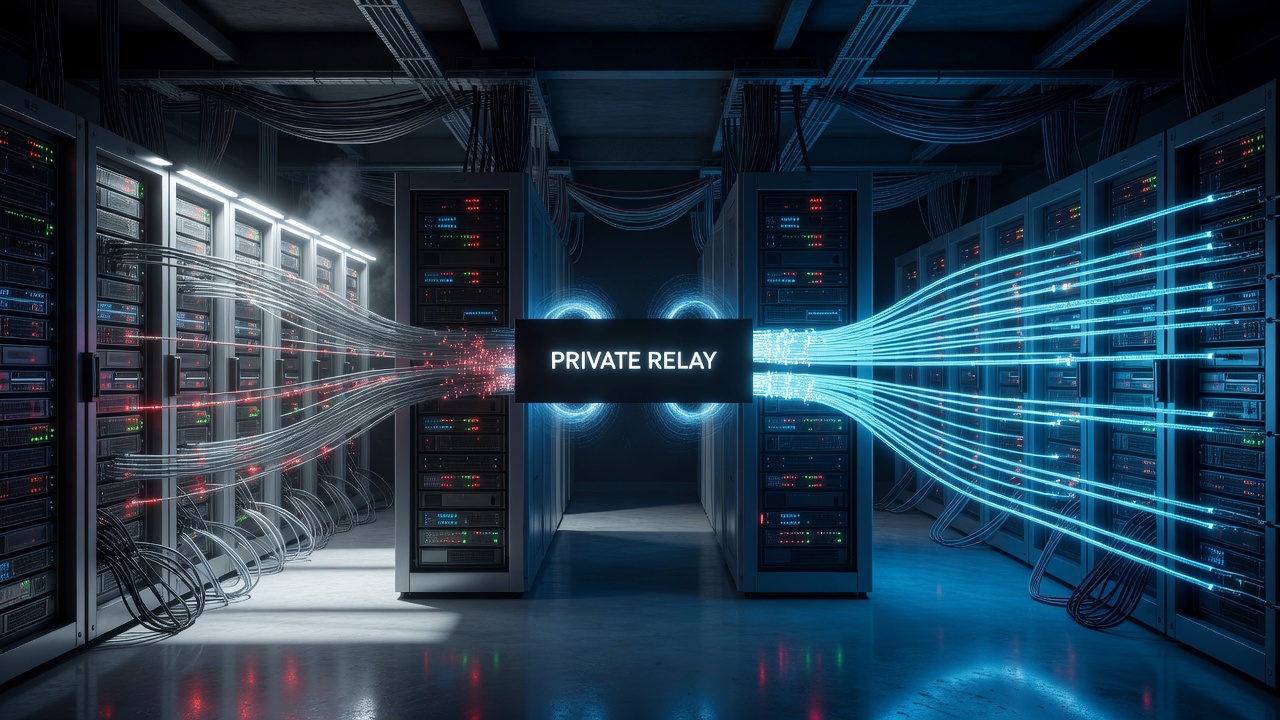
No single company can see both who you are and what you browse - that is the premise behind iCloud+ Private Relay, a privacy feature Apple folded into iOS 15 to shield Safari traffic from prying eyes. Rather than relying on a conventional encrypted tunnel to a single server, as most consumer privacy tools do, Apple built a system that deliberately splits knowledge of your identity from knowledge of your destination across two independent relays.
The idea responds to a long-standing weakness in everyday browsing: your internet service provider can see every domain you visit, and the sites themselves can see your IP address, location, and device details. Combined, these two vantage points let companies and intermediaries build detailed profiles of your habits over time. Private Relay does not eliminate the parties involved in that exchange - it isolates them from each other instead. For readers comparing this approach against other options, services such as the BuyBestVPN server network rely on a more traditional single-hop model, which is worth understanding before deciding which type of protection fits a given threat model.
How the Dual-Hop System Works
Private Relay routes traffic through two separate proxies rather than one. The first, an ingress proxy operated by Apple, receives your encrypted traffic and knows your real IP address - but not where you are headed, since the destination remains encrypted at this stage. The second, an egress proxy run by independent content delivery partners such as Fastly, Cloudflare, or Akamai, decrypts the destination address and connects you to the website, assigning a temporary, randomized IP address in the process. Crucially, this second relay never learns your actual IP address or device identity, because it only ever communicates with the first proxy, not with you directly.
This architecture echoes principles long used in anonymity networks like Tor, which also separate routing information across multiple nodes so no single point holds the full picture. Private Relay is narrower in scope and faster in practice, since it uses only two hops rather than three or more, but the underlying logic - distributing trust rather than concentrating it - is the same.
Encrypted DNS and Location Masking
Every time a browser resolves a web address, it normally sends a DNS lookup in plain text, a request that ISPs and network operators can log and monetize. Private Relay encrypts these lookups at the device level, closing off a channel that has historically been exploited for tracking and traffic analysis on both home and public networks.
Apple also gives users control over how much location precision they surrender. The "Maintain General Location" setting preserves an IP address tied to the user's approximate city or region, keeping locally relevant content like weather or news functional. The "Use Country and Time Zone" option strips this down further, revealing only a broad regional footprint and offering stronger protection against behavioral tracking, at the cost of some localized convenience.
What Private Relay Does Not Cover
The protection is deliberately scoped. It applies to Safari traffic, on-device DNS queries, and unencrypted HTTP requests from native apps - not to every network connection on the device. Traffic from third-party browsers, most app-based connections, and corporate or school networks that restrict relay services generally fall outside its reach. That distinction matters: Private Relay is a targeted privacy layer for web browsing, not a full virtual private network replacement, and users with broader anonymity needs, such as evading geographic content restrictions or securing all device traffic uniformly, will still need a dedicated VPN.